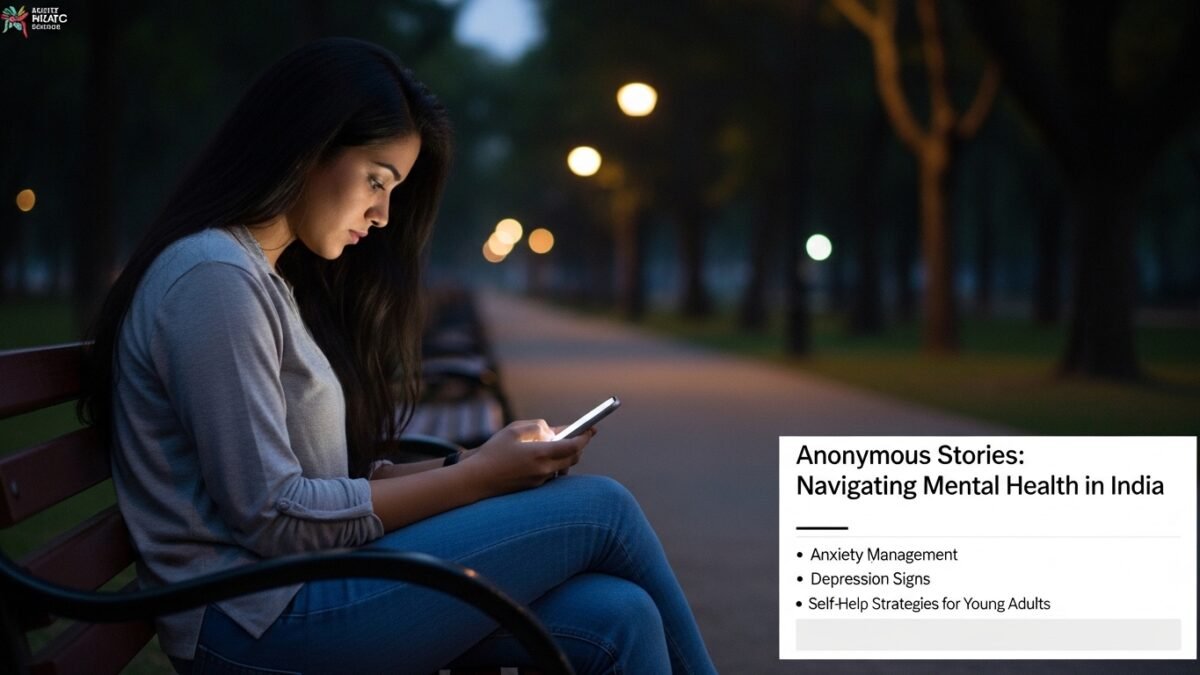
Anonymous Stories · Mental Health
A 25-year-old on the edge of collapse. No therapist. No breakthrough moment. Just the slow, unglamorous work of pulling yourself back from nothing — told the only way it can be told: without a name.
📅 April 2026⏱ ~12 min read✍ Agyat Vyakti
In This Thought
- What Mental Health Actually Is
- What Quietly Breaks It
- The Signs Nobody Talks About
- The Story — He Was 25 and Running Out
- How He Came Back (Not How You’d Expect)
- What You Can Actually Do — For Yourself
01. What Mental Health Actually Is
We use the phrase constantly now. Mental health. It’s on posters in school corridors, in company newsletters, in advertisements for apps that promise to fix it in ten minutes a day. And yet most people, if you asked them to explain what it actually means — not the definition, but what it feels like from the inside — would pause.
Mental health is not the absence of sadness. It is not constant happiness, or confidence, or the ability to wake up motivated every morning. Those things are moods, and moods are weather. Mental health is the ground beneath the weather — the soil’s capacity to absorb rain without flooding, to hold roots without cracking.
More precisely: mental health is your capacity to function, to feel, and to recover. To work without dissolving. To feel pain without being consumed by it. To bend under pressure and return, slowly, to something resembling your own shape.
The WHO Definition — Simplified
The World Health Organization defines mental health as a state of wellbeing in which a person can realise their own potential, cope with the normal stresses of life, work productively, and contribute to their community. Notice what is absent from that definition: perfection. Ease. The absence of struggle. Mental health includes struggle. It is the capacity to survive it.
Most people reading this already understand something is wrong — or was wrong — or might be starting to go wrong. You do not need a clinical vocabulary for that. You need someone to say it plainly. So here it is, plainly:
Mental health is the most important infrastructure you own. And unlike your phone or your body when it gets a cold, when it begins to fail, it fails quietly, gradually, and in ways that are almost impossible to explain to someone who has not felt it.
02. What Quietly Breaks It
Mental health does not break the way a bone breaks — sudden, with a sound, with a specific moment you can point to. It erodes. The way a coastline erodes. Slowly, invisibly, until one day you look and the ground you were standing on is simply gone.
There are things that accelerate the erosion that rarely get named honestly:
Chronic low-grade stress. Not a crisis. Not a disaster. Just the relentless, daily accumulation of small pressures that never fully resolve — the job that is always slightly too much, the relationship that is always slightly off, the finances that never quite stabilise. Individually, each one is manageable. Collectively, without rest, they wear the system down.
Social isolation — even when surrounded by people. You can be in a room full of people and feel completely alone. You can have 800 followers and no one who knows what you actually feel. Modern life has become extraordinarily efficient at producing a specific kind of loneliness — the kind that coexists with constant connectivity. This loneliness is particularly corrosive because it cannot be solved by simply being around more people. It requires being known by people. And being known requires vulnerability, which requires safety, which most of us do not have enough of.
Suppression as a long-term strategy. We learn early — most of us — that certain feelings are unacceptable. That anger is dangerous, that sadness is weakness, that anxiety is something to push through rather than sit with. So we suppress. We get very good at it. We look fine. We function. And then, years later, something relatively small triggers a collapse that looks disproportionate from the outside but makes complete sense on the inside — because the thing that broke was not the last straw. It was every straw that came before it.
The gap between who you are and who you are performing. This one is underestimated. When the person you show the world is significantly different from the person you are in private — when you maintain a performance of competence, positivity, or togetherness that does not reflect your actual internal state — the energy required for that performance quietly drains you. Not in a way you can easily measure. In a way that just leaves you tired in a place that sleep does not reach.
03. The Signs Nobody Talks About
Everyone knows the clinical signs — persistent sadness, loss of interest, changes in sleep and appetite. These are real. They matter. But there are other signs that are less discussed, signs that show up earlier, signs that are easier to dismiss as personality or laziness or just “a phase”:
Everything feels like effort. Not just hard things. Everything. Making a phone call. Replying to a message. Deciding what to eat. The cognitive load of ordinary daily life begins to exceed your available capacity. Tasks that used to take ten minutes now take an hour — not because you are slow, but because the overhead of starting them has become enormous.
You stop enjoying things that used to feel good. This is called anhedonia in clinical language, and it is one of the most disorienting symptoms of depression because it makes the solution — do things that make you feel better — functionally unavailable. The things that used to work have stopped working. The music sounds flat. The food is tasteless. The company of people who love you is something you endure rather than something you receive.
Your relationship with time changes. The future begins to feel abstract or threatening — not a place you are moving toward but a vague expanse of more of this. The past becomes heavier, more frequently revisited. The present is something to get through rather than inhabit.
You become very good at faking fine. You learn exactly what to say in response to “how are you?” You find the right amount of honesty to offer — enough to seem real, not enough to actually burden anyone, not enough to require them to do anything with the information. You perform okayness so consistently that even you sometimes believe it. Until you are alone and the performance has nowhere to go.
Small things feel catastrophic. A minor mistake at work. A message left on read. A plan that falls through. These land with a weight that is completely disproportionate to their actual significance, and you know that, and the gap between knowing it and feeling it correctly is its own form of suffering.
04. The Story — He Was 25 and Running Out
What follows was shared anonymously. Details have been generalised to protect the individual. This person chose to remain unknown — as all voices here do.
He was 25. He had a job. He had a room of his own. He had a phone full of contacts and almost no one he could call at 2am with the actual truth.
From the outside, the picture was unremarkable — a young man navigating his mid-twenties like most young men navigate their mid-twenties, with uncertainty and performance and the particular exhaustion of pretending you know what you are doing when you do not. Nothing catastrophic. Nothing dramatic. Just the slow erosion of a person who had been holding too much for too long without putting any of it down.
He had been like this for eight months before he named it. Eight months of waking up tired in a way that sleep did not fix. Eight months of going through every motion of a life that looked functional from a distance but felt, from the inside, like operating a machine he had no instruction manual for.
The job was fine. That was the absurd part — the job was fine. Not brutal, not cruel, just the specific kind of relentless that modern work tends to be. The expectations were always slightly ahead of his capacity. He was always almost keeping up. Never failing visibly. Never succeeding in a way that felt real. Just the perpetual almost of it, grinding at a frequency that nobody around him could hear.
He stopped reading. He had loved reading — had been the kind of person who read in transit and before sleep and during lunch. He noticed, one afternoon, that he had not finished a book in four months. He had started several. He could not retain them. The words went in and dissolved before they connected to anything.
He stopped calling people. Not consciously. There was no decision. He simply found, again and again, that he did not have the bandwidth. That the energy required to be present in a conversation — to listen, to respond, to maintain the performance of being okay — was more than he had available. So the calls became less frequent, and the messages went unreplied for longer, and the people who cared about him began to worry in the way people worry when they are not sure they have the right to say anything.
The nights were the worst of it. Not because anything happened at night — because nothing did. He would lie in the specific dark of his room and the thoughts would begin, and the thoughts had a quality he had never experienced before: they were not anxious in the way he had been anxious before exams or before difficult conversations. They were something duller and more total. A kind of grey certainty that nothing was going to be different. That this — this grey, effortful, hollow version of a life — was simply what his life was going to be.
He did not want to die. He needs to say that clearly, because he knows how this sounds. He was not in crisis in that way. He was in a different kind of crisis — the quieter one, the one that does not announce itself, the one that simply makes the texture of being alive feel like something you tolerate rather than something you inhabit.
The thing that frightened him most was the absence of a reason. He could not point to anything and say: this is why. He had a roof. He had money enough. He had people who loved him. The absence of a visible cause made the thing feel shameful in a specific way — as though he had no right to feel this way, as though feeling this way without a sufficient reason was a character flaw rather than a symptom.
He told no one for eight months. He kept the performance running. He went to work. He replied to messages, eventually. He appeared at the social occasions he could not avoid. He said fine and okay and a little tired when people asked. He got through the days the way you get through something you do not know how to stop being inside of.
The edge came on a Sunday in the middle of an ordinary afternoon. He was sitting with a cup of tea he had made and not drunk, looking at nothing, and he became aware — with the clarity that sometimes comes from exhaustion — that he could not do this for another year. That something had to change because the alternative to something changing was continuing exactly like this, indefinitely, and that felt impossible.
Not dangerous. Not dramatic. Just impossible. And impossible, it turned out, was enough.
05. How He Came Back — Not How You’d Expect
He did not book a therapy appointment that afternoon. He could not afford it, and more than that, he did not yet believe he deserved one — a thought he now recognises as part of the illness rather than an accurate assessment of the situation.
What he did was simpler and stranger and more embarrassing to admit: he wrote it down.
Not in a journal with a system. Not in a way that was meant to be seen. He opened the notes app on his phone and wrote, in the most unfiltered language he could manage, exactly what was happening. Not the performed version. Not the version that would make sense to someone else. The actual version — the grey certainty, the exhaustion, the eight months, the undruggable tea.
It took twenty minutes. He read it back. And for reasons he still cannot fully explain, the act of naming the thing — precisely, privately, without softening it — reduced its weight by something measurable. Not eliminated. Not resolved. Reduced. The thing that had been formless and total had a shape now, and shapes are easier to be in relationship with than totality.
He started doing this every day. Not as a practice. Not as a self-improvement project. Simply because it seemed to do something, and he needed something that did something.
Then, slowly, he told one person. Not everything. Not the eight months. Just enough — just the edge of it — to a person he had known long enough to trust with something real. The person did not fix it. The person could not fix it. What the person did was receive it without flinching, without immediately offering solutions, without making it smaller than it was. That was enough. That was, in fact, enormous.
He began walking. Twenty minutes in the morning, before the day began its demands. Not for fitness. Not with a destination. Just movement — the body doing something simple and physical that required no cognitive overhead, that produced no performance pressure, that was just: legs, pavement, air.
He started sleeping at a consistent time. Not because someone told him sleep hygiene was important — he knew that, theoretically, the way you know many things theoretically without applying them. He started doing it because the nights were the worst of it, and he needed to change something about the nights, and sleep time was the only variable he could actually control.
He began, gradually and without dramatic announcement, to say no to things. Not everything. Just the things that cost more than they gave. The social obligations that left him more depleted than before. The commitments made from guilt rather than desire. The performances of okayness for audiences who would not notice if he quietly stepped back. He reclaimed, in small increments, the energy he had been spending on things that were not feeding him.
None of this was linear. There were weeks that were worse than the week before. There were days when the writing felt pointless and the walk felt like penance and the one person he had told was unavailable and the grey certainty returned in full. Those days did not mean it was not working. Those days were just part of it.
Six months later — not better in a way that would make a good story, but better in a way that was real — he described it like this: I stopped waiting for the feeling to change before I changed the behaviour. I changed the behaviour first and let the feeling be whatever it needed to be while the behaviour happened. Eventually the feeling started, slowly, to follow.
He saw a counsellor eventually. A few sessions through a free service he found after some research. It helped. He wishes he had done it sooner. He understands why he didn’t. Both things are true.
06. What You Can Actually Do — For Yourself
This section is not a list of tips. It is not a wellness framework. It is an honest account of what actually seems to move the needle, drawn from the experience above and from everything written and spoken by people who have been in similar places.
Name it, privately and precisely. Not “I feel bad.” Precisely. Write down what is actually happening, without the softening, without the justifications, without the performance. The act of precise naming is not just cathartic — it is cognitively significant. It moves the experience from the amygdala’s territory into the prefrontal cortex’s territory. It makes the formless thing into a shaped thing. Shaped things are survivable in ways that formless things are not.
Tell one person one true thing. Not the whole story. Not the performed version. One true sentence to one person who can receive it. “I have been struggling more than I’ve let on” is enough. The point is not the information transfer. The point is the breaking of the isolation — the single most corrosive element in prolonged poor mental health.
Change one physical input. The mind and body are not separate systems. Sleep, movement, food, light — these are not luxury variables. They are inputs into the system that produces your mental experience. You do not have to overhaul everything. Change one thing. Consistently. For two weeks. See what it does.
Reduce the cost of one thing you do not have to do. Mental health is partly an energy equation. If the outgoings consistently exceed the income, the account goes negative. Identify one thing in your life that costs energy without returning it — one obligation, one relationship, one habit — and reduce your investment in it. Not dramatically. Not with announcement. Just slightly less than before.
Stop waiting for the feeling to lead. The logic of “I’ll do it when I feel better” is precisely backwards when the feeling is depression or near-depression. The feeling does not improve and then cause the behaviour. The behaviour changes, with or without the feeling, and the feeling — eventually, slowly, with no fanfare — follows. This is not a motivational statement. It is how the neuroscience of habit formation works.
Seek professional support when you can, without shame. Free resources exist in India — iCall (9152987821), Vandrevala Foundation (1860-2662-345), and iMind (080-46110007) among others. A counsellor is not a last resort. It is a resource. Using a resource is not weakness. It is the opposite of weakness — it is the recognition that the system you are working with is complicated and that outside perspective has value.
If You Are in Crisis Right Now
If you are at the edge — not the grey edge, but the sharp one — please call iCall at 9152987821 or the Vandrevala Foundation at 1860-2662-345. Both are free. Both are available. You do not have to explain yourself perfectly. You just have to call.
He is still anonymous. He chose to remain so, because the experience belongs to him in a way that sharing it with his name attached would complicate. But he chose to share it at all because he spent eight months believing he was the only one feeling what he was feeling, and he was not. He was never the only one.
Neither are you.
“Mental health is not a destination you arrive at. It is a relationship you maintain — imperfectly, inconsistently, without a final answer — with the person you are still in the process of becoming.”— Agyat Vyakti
agyatvyakti.com · Anonymous Stories · April 2026
Every word belongs to no one. Every word belongs to you.