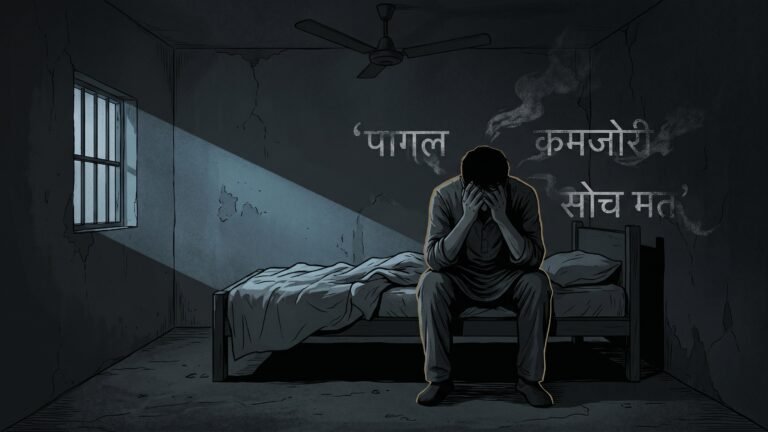
Before you chose a career, a partner, a haircut, a voice — there was a question. Not yours. Theirs. Four words, so rehearsed they arrived before thought itself: log kya kahenge. What will people say.
You learned to run your life through that question the way a surgeon runs a scalpel — with precision, with habit, with the quiet assumption that this was simply how decisions were made. Not by desire. Not by conviction. By the imagined verdict of a court that never actually assembled, never formally convened, never once asked your side of the story.
You have carried this your whole life and called it being responsible. Being good. Being Indian.
Psychologists have a different word for it.
The Difference Between Guilt and Shame (And Why It Changes Everything)
Most people use guilt and shame as synonyms. They are not. The distinction is precise, and it matters more than almost anything else in understanding what log kya kahenge actually does to a person.
Guilt says: I did something bad.
Shame says: I am something bad.
Guilt is action-focused. It can be repaired. You did wrong, you acknowledge it, you make amends, you move forward. Guilt is uncomfortable but it is, in the language of developmental psychology, adaptive — it connects behaviour to consequence and drives moral correction.
Shame is identity-focused. It cannot be repaired — because it does not locate the problem in what you did. It locates the problem in what you are. And what you are cannot be fixed by doing something differently. It can only be hidden.
The researcher Brené Brown, who has spent two decades studying shame, identifies this as its central and most destructive mechanism: “Shame is the intensely painful feeling or experience of believing that we are flawed and therefore unworthy of love and belonging.” Not what we did. What we are.
Now consider what log kya kahenge actually communicates — in the ten thousand moments it was deployed on you across childhood and adolescence:
You danced too freely at a wedding. Log kya kahenge. Not: that specific dance was inappropriate for that specific occasion. But: the kind of person who dances like that is the kind of person we are ashamed of.
You wore something that showed too much of yourself. Log kya kahenge. Not: that outfit conflicts with today’s dress code. But: your body, displayed, is something to be ashamed of.
You chose the wrong subject. The wrong partner. The wrong ambition. The wrong laugh. Log kya kahenge — each time attaching the word wrong not to a choice, but to the chooser.
This is how guilt becomes shame. Repetition. Consistency. The slow, relentless message that the problem is not what you did, but the fact that you — this version of you, the wanting, expressing, desiring you — exists at all.
How a Culture Manufactures Shame (Without Ever Meaning To)
Here is something important to hold: the people who said log kya kahenge to you were not villains. They were, almost without exception, people who loved you — or believed they did — and who were themselves operating inside a system so old and so total that questioning it would have felt like questioning gravity.
Collectivist cultures — and India is one of the world’s most deeply collectivist — are not built on individual identity. They are built on relational identity. You are not primarily you. You are a son, a daughter, a bahu, a beta, a member of a community, a representative of a family name that existed before you and will exist after you. Your individual life is, in this framework, less a life than a performance — staged for an audience that includes the living, the dead, and the not-yet-born.
This is not inherently pathological. Collectivism produces genuine goods — solidarity, intergenerational care, communal belonging, the felt sense that you are held by something larger than yourself. These are not trivial things. Many individualist cultures have lost them entirely and are visibly suffering for it.
But collectivism has a shadow. And the shadow is this: when the group’s perception of you becomes the primary source of your worth, you become structurally dependent on the group’s approval for your psychological survival. Your self-esteem — your very sense of existing as a legitimate being — is outsourced. It no longer lives inside you. It lives in them.
The psychological term for this is externally contingent self-esteem. Your sense of your own value rises and falls not with your own assessment of yourself, but with your read — often your anxious, distorted, catastrophising read — of how others are assessing you.
And in a culture where log kya kahenge is the operating principle, this is not a personality quirk. It is the water everyone swims in. It is the architecture of the self that gets built inside every child who grows up hearing those four words aimed at every expression of authentic desire.
What Chronic Shame Actually Does to the Body and Mind
Shame is not only a feeling. It is a physiological event.
When shame activates — when the internal alarm reads I am being seen as defective — the body responds as it responds to physical threat. Cortisol floods the system. The face flushes or drains. The gaze drops. The shoulders fold inward. The voice loses volume. The breath shallows. This is the shame response: the body attempting to make itself smaller, less visible, less of a target.
In acute moments — a public embarrassment, a humiliating confrontation — this response is temporary. It passes. The cortisol clears. The shoulders lift again.
But in chronic shame, the alarm never fully turns off. The body — trained by years of log kya kahenge, by years of learning that its authentic expression was dangerous — begins to run the shame response as a background process. Not triggered by specific events. Running constantly. Quietly. Like an app left open that drains the battery without you noticing.
The consequences of this, documented across decades of research in developmental psychology and affective neuroscience, are not small:
Chronic self-monitoring. You cannot stop watching yourself from the outside. Every room you enter, you are simultaneously in it and observing yourself from across it, running a continuous threat assessment: How am I being perceived? Is this too much? Too loud? Too direct? Too visible? This consumes enormous cognitive resources — resources that are not available for actual thinking, actual presence, actual connection.
Preemptive self-erasure. Before anyone can reject you, you reject yourself. Before anyone can find you wanting, you have already found yourself wanting and adjusted accordingly. You don’t say the thing you want to say. You don’t wear what you want to wear. You don’t pursue what you actually want to pursue. Not because you have examined these things and decided against them — but because the shame circuitry fires before the decision-making circuitry can even engage. You have been pre-filtered out of your own life.
Rage that has nowhere to go. Shame, when it cannot be processed, converts. Sometimes it converts into depression — the inward collapse, the withdrawal, the self that has been told so many times it is wrong that it finally agrees and stops trying. Sometimes it converts into narcissism — the overcorrection, the grandiosity, the armour of superiority built to protect against the unbearable sense of being fundamentally not enough. And sometimes it converts into something that looks like anger but is really grief — the fury of someone who has spent a lifetime performing for an audience they never chose, for a verdict they never received, toward a belonging they were promised but never actually given.
The inability to receive love. This is perhaps the most quietly devastating consequence. Chronic shame makes genuine intimacy structurally impossible — because intimacy requires being seen, and being seen is the thing shame has taught you is dangerous. People who chronically shame-manage cannot accept care without suspecting it. Cannot be praised without deflecting it. Cannot be truly known without feeling the constant terror that if this person actually knew you — saw the real, unperformed, unfiltered you — they would leave. And so you perform, even in the relationships where you most desperately want to stop performing. And the loneliness inside those performances is a specific kind of loneliness that has no name in the languages you were given.
The Phantom Audience
Here is the thing nobody tells you about log kya kahenge: the log are largely imaginary.
Not entirely. Social consequences are real. Reputations exist. Communities remember things. The lived experience of caste-based social sanction, of community ostracism, of family exile — these are not figments. For many people in India, particularly women, the cost of violating log kya kahenge norms has been — and continues to be — genuinely severe.
But the version of log that lives inside the shame-conditioned mind is not the actual community. It is a psychological construct — a composite, a fiction assembled from fragments of memory, anxiety, projection, and catastrophic thinking. It is the neighbour who commented once in 2009. It is the aunt who raised an eyebrow. It is the classmate who whispered. It is the father’s silence after a particular announcement.
These fragments have been assembled in your mind into a permanent, omniscient, permanently-present jury — one that is always watching, always judging, always finding you marginal. And this jury has been so thoroughly internalised that you no longer need the actual people to trigger it. You carry it everywhere. You bring it to every room. It sits beside you while you eat, lies next to you at 3am, weighs every word before you speak it.
Psychologists call this the internalised critical other — the voice that speaks in the second person (who do you think you are), that sounds suspiciously like specific people from your past, but is now fully autonomous, a resident of your own mind, running without external input.
You think you are living in response to a society. You are living in response to a ghost.
What Healing Actually Looks Like (And Why It Is Not What You Think)
The therapeutic literature on chronic shame is careful about this: healing shame is not the same as eliminating sensitivity to others’ perceptions. That would not be healing. That would be producing a sociopath.
The goal is not to stop caring what people think. The goal is to relocate the headquarters of your self-worth from their minds to your own.
This is a slow, non-linear, often physically uncomfortable process. It cannot be completed by reading this essay, including this one. But the direction is precise:
Name the shame in real time. The shame response moves fast — it fires before consciousness can catch it. Learning to name it as it happens (this is shame activating, this is not a factual assessment of my worth, this is an old alarm misfiring) begins to insert a gap between stimulus and collapse. Small at first. But the gap is where agency lives.
Distinguish the real audience from the phantom one. When log kya kahenge activates, ask: which specific person is actually watching this specific moment and actually forming a verdict that actually matters? Most of the time, the honest answer is: no one. Or: someone who will not remember this in a week. The phantom audience requires specificity to dissolve.
Grieve what the shame cost you. This is the step most people skip. There is real loss here — the version of yourself that did not get to develop because it was pre-emptively edited out. The ambitions that were never pursued. The relationships that were never allowed to be real. The voice that was kept at a managed volume. Chronic shame cannot heal without mourning what it consumed. This grief is not self-pity. It is the honest accounting of a debt that was charged to you before you were old enough to consent to the terms.
Tolerate being seen imperfectly. Shame heals in relationship — specifically, in relationships where you allow yourself to be seen in your incompleteness and discover that you are not thereby destroyed. This is what Brené Brown means when she says shame cannot survive being spoken. Not because speaking it magically dissolves it — but because speaking it in the presence of a safe witness proves, experientially, that the catastrophe the shame predicted did not occur. That proof accumulates. Slowly. Into something that functions like trust — not in others exactly, but in your own survivability.
Refuse the inheritance — consciously, specifically, repeatedly. Log kya kahenge was handed to you. You did not generate it. You were not consulted. It arrived in the hands of people who received it in the same way — as an inheritance from people who received it the same way, stretching back through generations of people who were trying, in the only way they knew, to keep their children safe inside a world that punished difference severely.
You can understand all of that — the love inside the transmission, the fear inside the love — and still choose not to pass it forward. Understanding is not the same as perpetuating. You can grieve the wound and close the cycle. Not easily. Not once. But deliberately, repeatedly, as a practice — the way you would practice any other form of freedom.
A Final Note, Addressed to You Specifically
You have spent so much of your life trying to be the version of yourself that would finally — finally — make the imaginary jury nod. Get the right job, make the right marriage, wear the right expression, achieve the right amount, stay within the right borders of acceptable personhood.
And it has never been enough. Not because you failed — but because the game was structured to never have an ending. There is no verdict from log that settles the case permanently. There is no performance that retires the performer. The only exit from the game is to stop playing — not in bitterness, not in the adolescent performance of not-caring-what-anyone-thinks, but in the quiet, difficult, ongoing act of relocating your authority over your own worth from the imagined outside to the actual inside.
Your ancestors said log kya kahenge because they survived inside a world where community sanction was often a matter of physical survival. The fear was real. The adaptation made sense.
You are living inside a different world. Not a perfect one. Not one without consequence. But one in which — perhaps for the first time in your bloodline — you have enough safety to ask: what do I actually think? What do I actually want? Who am I, specifically, when I am not performing for the jury?
That question is not selfish. It is, in fact, the most serious question available to a human being. And you have spent too long not asking it.
The logs will say what the logs will say.
They always do.
The question is whether you will still be listening.
References & Further Reading
Brown, B. (2010). The Gifts of Imperfection. Hazelden Publishing. — On shame resilience and the distinction between shame and guilt.
Kaufman, G. (1989). The Psychology of Shame. Springer Publishing. — Foundational clinical text on shame’s developmental origins.
Tangney, J.P. & Dearing, R.L. (2002). Shame and Guilt. Guilford Press. — Research on the distinction between shame-prone and guilt-prone responses.
Roland, A. (1988). In Search of Self in India and Japan. Princeton University Press. — On relational selfhood and collectivist identity in South Asia.
Nathanson, D.L. (1992). Shame and Pride. W.W. Norton. — The Compass of Shame model: withdrawal, avoidance, attack self, attack others.