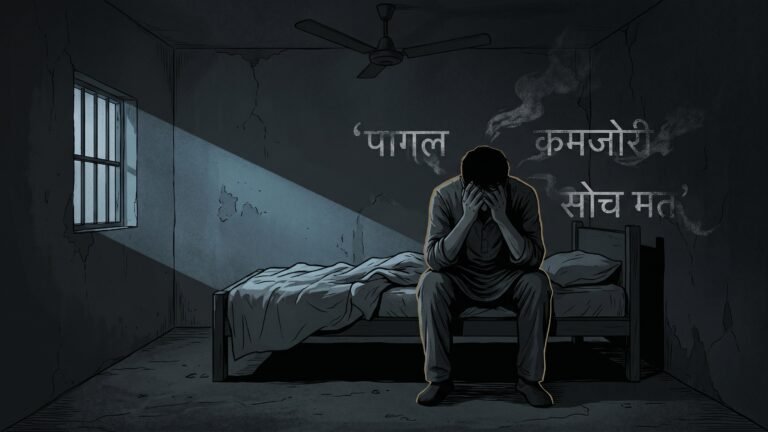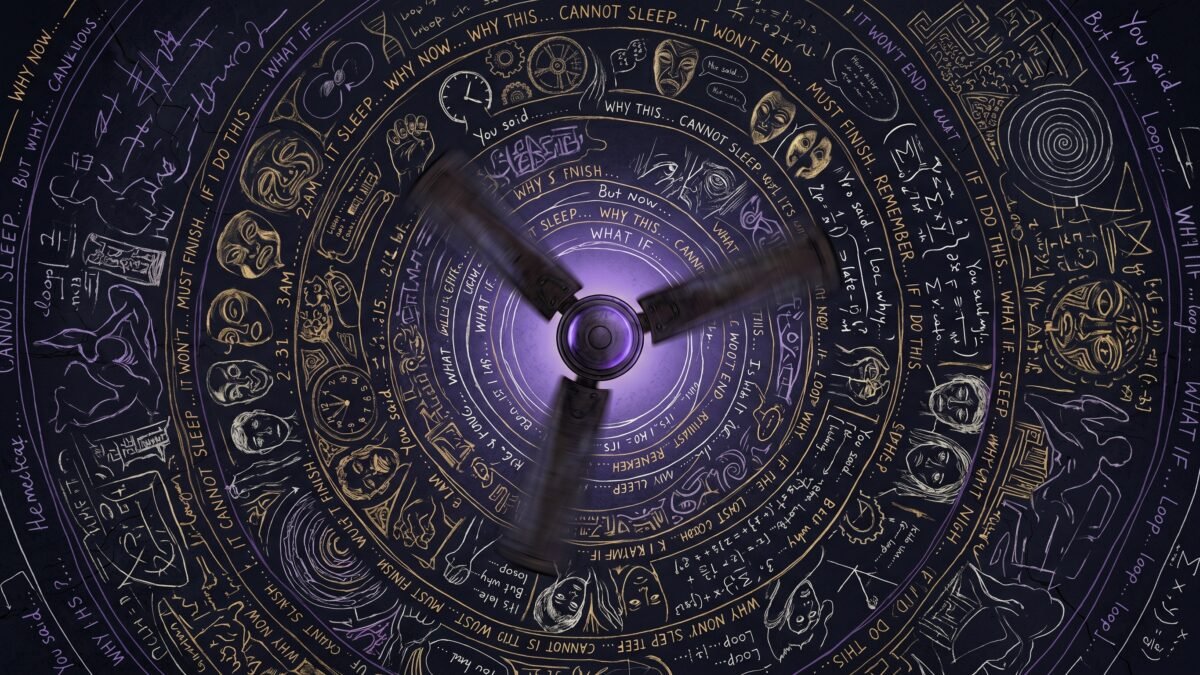
2AM. The ceiling. The same thought for the fourth time, only slightly worse now because you know it’s the fourth time. You are not asleep. You are not awake in any useful sense. You are in the particular purgatory that India has decided to call a personality problem.
The thought loops. It modifies slightly — a different version of the same worst-case scenario, a conversation that happened three years ago edited to include what you should have said, a decision coming tomorrow that may or may not matter but feels, at this moment, like it determines everything. The body is tense. The room is dark. Nothing is happening. Everything is happening.
India will tell you, in the morning, that you think too much.
India is not wrong that something is happening. It is wrong about what.
The Anatomy of a Night
The day ends. The stimulation stops. The noise that kept the mind occupied withdraws. What was underneath the noise is now audible.
The first loop begins. Not a new thought — a returning one. Something unresolved. The mind is attempting to complete a process it was interrupted from completing.
The loop has now absorbed adjacent thoughts. The original concern has recruited reinforcements: past failures, future uncertainties, everything that connects to this feeling of not-enough.
The body has now joined. Chest slightly tight. Impossible to find a comfortable position. The mind monitoring the body monitoring the mind.
Exhaustion but no sleep. The thought is now familiar enough to feel permanent. The person wonders if this is simply who they are. India would confirm: yes. This is just who you are. You overthink.
They function. Nobody notices. Nobody asks. The night is filed under personal weakness and not mentioned again.
What Is Actually Happening
Rumination is not a choice. It is a mechanism.
The clinical term for what India calls overthinking at night is rumination — the involuntary, repetitive mental processing of distressing thoughts or experiences. It is a well-documented psychological phenomenon, extensively studied, associated specifically with anxiety and depression, and it is not something a person is doing intentionally.
Rumination is the mind attempting to solve an unsolvable problem — or more precisely, a problem it has decided cannot be set down. The thoughts return not because the person is weak or undisciplined but because the nervous system has flagged something as unresolved and keeps returning to it the way a tongue returns to a broken tooth. It is not a character trait. It is a process.
Rise in anxiety and insomnia searches in India in 2024.
“How to stop overthinking at night” is among the highest-volume mental health queries Indians type.
They are not looking for philosophy. They are looking for one night of sleep.
Why it happens at night specifically
The night is not incidental. Overthinking intensifies after dark for neurological reasons that have nothing to do with willpower:
Default Mode Network activation
When the brain is not engaged with a task, the Default Mode Network activates. This network is associated with self-referential thought — thinking about yourself, your past, your future, your failures. At night, with no task to focus on, it runs unchecked.
Cortisol rhythm disruption
Chronic stress disrupts the body’s cortisol cycle. Instead of dropping at night as it should, cortisol remains elevated — keeping the mind alert and the threat-detection system active when it should be offline.
Emotional suppression throughout the day
India requires high levels of emotional regulation in daily life — at work, with family, in public. Feelings that were managed and suppressed during the day do not disappear. They process at night, when the performance is over and the audience is gone.
Absence of resolution
In a culture where problems are endured rather than addressed — where talking about feelings is weakness, therapy is for the broken, and the answer to everything is “adjust karo” — nothing is ever genuinely resolved. The mind revisits what was never closed.
India’s Response to the Person Who Cannot Sleep
“The person who cannot sleep is not making a mistake. They are experiencing something that their life, their culture, and their nervous system have built together — and nobody has helped them dismantle.”
Why India Made It a Character Flaw
The economy of suffering in a country without enough support
India has one psychiatrist for every three hundred thousand people. The global recommended standard is one for every ten thousand. In this landscape, calling overthinking a character flaw is not cruelty. It is rationing.
When a society cannot provide treatment, it must provide an alternative framework. The alternative framework India chose is moral. You are like this because you are weak. You are weak because you lack discipline. You lack discipline because you have not tried hard enough. This framework costs nothing to deploy. It requires no infrastructure. It places the entire burden of an undertreated mental health crisis onto the individual who is already struggling to carry it.
The character flaw framework also serves a social function. If overthinking is a choice, then the people around the person are absolved. They do not need to help. They do not need to change anything. They can offer advice — soch mat itna — and return to their lives feeling they have contributed something.
India has 10.5% prevalence of mental disorders. 84.5% treatment gap. The math of those two numbers together means that tens of millions of people are suffering in a cultural framework that calls their suffering a personality problem. The nights are long. Nobody asks about them in the morning.
What the Research Actually Shows
This is not a list of tips. Tips are India’s preferred format for mental suffering — digestible, shareable, and minimally effective. What the research shows is less comfortable:
Rumination responds to treatment. Specifically to cognitive behavioural approaches, to structured problem-solving, to mindfulness practices used consistently over time — not as an evening’s hobby but as a deliberate therapeutic intervention. It also responds, in many cases, to medication that addresses the underlying anxiety or depression driving the rumination.
The night thoughts are not the problem. They are a symptom. Treating only the night thoughts — with sleep hygiene advice, screen time rules, breathing exercises — is the equivalent of treating only the fever while ignoring the infection. It may offer temporary relief. It will not resolve the underlying state.
Being heard interrupts the loop. Not fixed. Not advised. Heard. The research on rumination consistently shows that genuine acknowledgement — having the experience validated by another person — reduces its intensity. India has made validation scarce. The nights got longer.
It is 2AM somewhere in India right now. Someone is staring at the ceiling, running the same thought for the fourth time, feeling the particular shame of a mind that will not cooperate. They have been told, on multiple occasions, that this is a problem with their character.
It is not a problem with their character. It is a problem with a system — educational, cultural, familial — that has accumulated inside a nervous system that was never given the tools to process what it was asked to carry.
India will say: soch mat itna.
The ceiling offers no such counsel. It just waits.