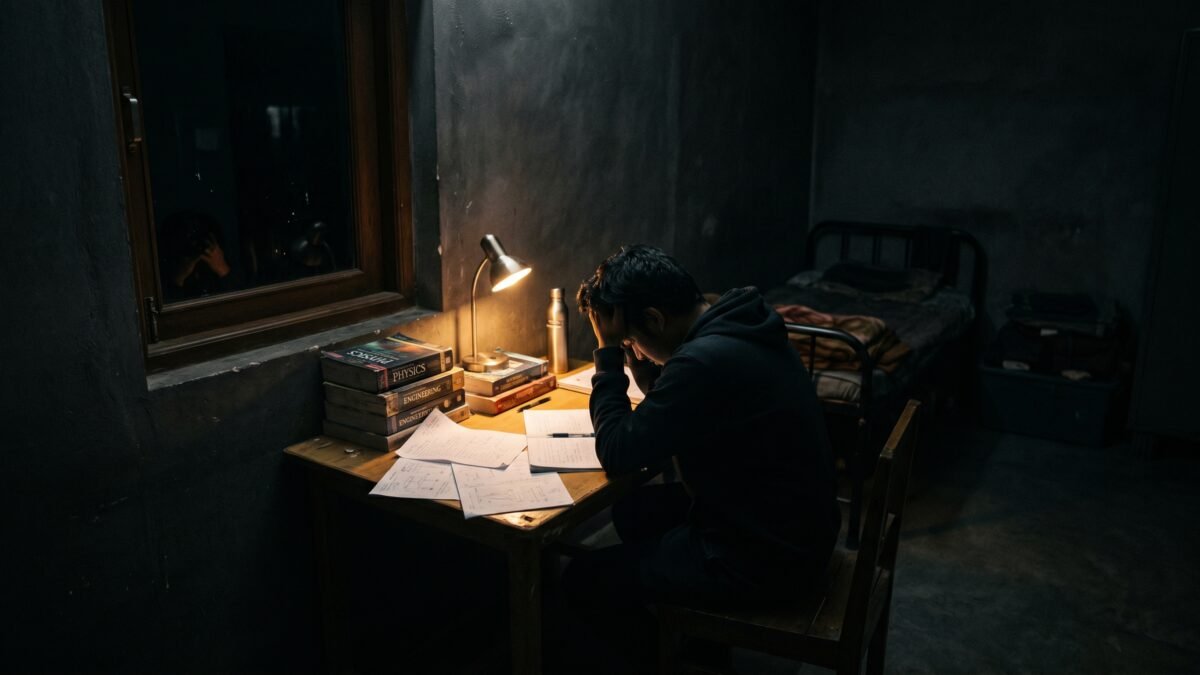
“Every year, 2 lakh students travel to a city in Rajasthan with a single purpose. Some come back as doctors and engineers. Some don’t come back at all.”
There is a city in India where ambition has been industrialised.
Where a 16-year-old wakes up at 5 AM, attends 8 hours of coaching, completes 4 hours of homework, takes two weekly tests, gets ranked publicly against 50,000 other teenagers — and then does it again tomorrow. And the day after. For two years.
That city is Kota, Rajasthan. And what happens inside it is not education. It is something else.
This is not an article against ambition. It is an attempt to understand what happens when a system is designed to produce results — and not people.
The Numbers
Let us start with what is verified. Not reported with emotion. Not framed with agenda. Just the data as it exists.
Verified data — Kota 2023–2024
- Over 2,00,000 students arrive in Kota every year to prepare for JEE and NEET
- 32 student suicides recorded in Kota in 2023 — the highest figure since 2015
- 17 suicides recorded in Kota in just the first five months of 2024
- 44.45% of coaching aspirants in Kota experience high levels of academic stress
- For comparison: only 3.33% of non-coaching students in the same city report the same stress levels
- 4 in 10 coaching aspirants in Kota show signs of depression
- Nationally, 13,089 students died by suicide in India in 2021 (NCRB data)
- Student suicides in India rose 21% between 2019 and 2021
- In India, at least one student dies by suicide every hour
Sources: NCRB data, Sage Journals (2025), PubMed/PMC research studies, Value in Health (2024)
Read those numbers again. Not as statistics. As lives.
Each number was a 16 or 17-year-old who woke up one morning and decided that the weight was too much. A person who, somewhere in the arithmetic of IIT ranks and parental dreams and monthly test scores, concluded that not existing was easier than continuing.
What Kota Actually Is
Kota is not a place that became a coaching hub by accident. It is a deliberately built machine.
It started in the 1980s with one physics teacher — V.K. Bansal — who began preparing students for IIT JEE from his home. His results were exceptional. Word spread. Other teachers followed. Institutes opened. Hostels were built. An entire economy grew around the preparation of 16-year-olds for one exam.
Today, over 100 coaching institutes operate in Kota. The city’s economy depends on these students. Hostel owners, tiffin services, stationary shops, transport operators — the entire infrastructure exists because 2 lakh teenagers arrive every year to study.
The incentive of the city is not for these students to be mentally healthy. The incentive is for them to stay, to pay fees, and to produce results that the institutes can advertise.
When the system’s incentive is not your wellbeing, you are not a person in that system. You are an input.
The Architecture of Pressure
To understand what breaks students in Kota, you have to understand what a typical day looks like.
A student arrives in Kota at 15 or 16 — often for the first time away from home. They are placed in a hostel with strangers. They attend coaching classes for 6–8 hours. They have 4–6 hours of self-study expected each day. They take weekly and monthly tests that rank them publicly. Based on those rankings, they are moved between batches — up if they perform, down if they don’t.
The batch movement is particularly damaging. Being moved down is not a private failure — it is a public one. Your peers know. Your hostel-mates know. When results are communicated to parents, they know too.
Research shows that most students in Kota are enrolled in dummy schools — schools that mark attendance without requiring physical presence, so students can spend all their time at coaching. This means no sports. No cultural activities. No art. No friendship outside the competitive environment. No life outside the one metric that matters: rank.
The isolation compounds everything. A 17-year-old, away from home, under academic pressure, socially isolated, with no outlets, and with monthly rankings that determine their self-worth — this is not a learning environment. It is a pressure cooker with no valve.
“44.45% of coaching students in Kota experience high academic stress. Among non-coaching students in the same city, that figure is 3.33%. The city itself is not the problem. The system is.”
The Myth of Merit
India has a particular relationship with competitive exams. They are presented as meritocracy — the great equaliser, the path that is available to everyone regardless of background.
This is true in theory. In practice, JEE Advanced produces around 16,000 qualified candidates each year from a pool of roughly 5 lakh applicants. NEET produces around 1 lakh qualified candidates from over 20 lakh applicants. The failure rate is not a side effect. It is the system working as designed.
What this means is that the vast majority of students in Kota will not get what they came for. They will spend two years of their most formative years in intense pressure, and most will leave without the outcome that was promised — or more accurately, implied.
This is not a critique of difficulty or of selective institutions. Some selection is necessary. The critique is of the narrative sold to 15-year-olds and their families: that if you just work hard enough, you will make it. That failure is always personal, never structural. That the problem, if there is one, is always you.
When 4 in 10 students are showing signs of depression, the problem is not 4 in 10 individuals. The problem is the environment they have been placed in.
The Role of Parents
The Supreme Court of India, reviewing student suicide cases from Kota, stated that it is parental expectations — not coaching institutes — that drive students to the edge.
This is a partial truth, and it needs careful handling.
Most parents who send their children to Kota are not cruel. They are people who grew up in a country where education was the only reliable ladder out of limited circumstances. They have genuinely absorbed the belief that an IIT or AIIMS degree changes everything — because for their generation, it often did.
The problem is that love, when it is expressed entirely through expectations, stops feeling like love to the person receiving it. A child who knows that their parents have spent their savings on coaching fees, who sees the financial sacrifice, who understands what it means to their family — that child cannot afford to fail. The weight of gratitude becomes indistinguishable from the weight of pressure.
The conversation India needs to have is not about whether parents love their children. Of course they do. The conversation is about what we as a society communicate to children about what their worth is tied to — and what happens to a person when that worth is calculated entirely in rank.
What Actually Needs to Change
The district administration of Kota has introduced interventions — mandatory counselling modules, welfare officers, restrictions on publishing batch rankings, removal of ceiling fans in hostel rooms (a method commonly used in suicides).
These are responses to symptoms, not causes. You cannot fix a structural crisis with furniture changes.
What research recommends, and what common sense confirms:
- Mandatory mental health screenings before admission and at regular intervals
- Peer support programmes that reduce isolation
- Physical activity and extracurricular space — not as a luxury but as a non-negotiable
- Parental education programmes that decouple love from performance expectations
- An honest national conversation about what happens to the 80–90% who do not qualify
- Reducing the volume of material crammed into coaching schedules
- Anonymous, accessible mental health support that does not require a student to identify themselves to their institute or their parents
None of these require the system to be destroyed. They require the system to acknowledge that it is dealing with human beings, not with variables in an optimisation problem.
If You Are Reading This From Inside That System
If you are a student currently in Kota, or preparing for JEE or NEET, or in any environment where the pressure feels like it is exceeding your capacity to carry it — this is for you.
What you are feeling is not weakness. It is a rational response to an irrational amount of pressure placed on a person who has not yet finished developing. The research does not say that some students are weak. It says the environment produces these outcomes at scale. You are not the exception. You are the expected result of a broken system.
Your rank is not your worth. This is said so often it has become meaningless, so let me say it differently: the version of you that fails JEE is still a person. The version of you that does not get NEET rank 1 still has a life worth living. The exam measures a specific set of skills under specific conditions — it does not measure curiosity, creativity, resilience, character, or the ability to build something that matters.
The system is designed to make you feel like it measures everything. It does not.
If you are in crisis right now
You do not need to manage this alone. Talking to someone is not failure — it is one of the most difficult things a person under pressure can do.
- iCall (TISS): 9152987821 — free, confidential, professionally trained counsellors
- Vandrevala Foundation: 1860-2662-345 — 24/7, free, multilingual
- AASRA: 9820466627 — 24 hours
- iMind: available online — text-based counselling if speaking feels too difficult
The city of Kota will continue. The coaching institutes will continue. The exams will continue. None of that is going to change tomorrow. What can change — what has to change — is the conversation we have with young people about what their life is worth outside of a rank. That conversation starts now. It starts with you reading this. It starts with you choosing to be here tomorrow.
— Agyat Vyakti
Kota coaching pressure, student mental health India, Kota suicides 2023, JEE NEET mental health, academic pressure India, coaching student depression, Kota Rajasthan students, student suicide India, NCRB student suicide data, youth mental health India, iit jee pressure, neet preparation stress, kota student crisis, India education system mental health, parental pressure India students, competitive exam stress India, student wellbeing India, mental health coaching hub, kota system critique, india exam culture