Reality

“India is the world’s most populous democracy. It is also, quietly, one of the most mentally unwell — and one of the least equipped to acknowledge that fact.”
Mental health in India is discussed in two registers: the inspirational and the invisible.
The inspirational: celebrities talking about therapy, brands running World Mental Health Day campaigns, startups raising funding for wellness apps. The invisible: 200 million people living with conditions that are untreated, unnamed, and unseen — not because help doesn’t exist anywhere in the world, but because it does not exist for them, in their language, in their town, at a price they can pay.
This is not a post about awareness. Awareness without access is a performance. This is a post about the data — what it says, what it means, and what it reveals about a country that has not yet decided whether its people’s minds are worth the investment.
The Number India Doesn’t Talk About
According to government data and multiple peer-reviewed studies, 15% of India’s adult population experiences mental health issues requiring intervention. That is approximately 200 million people — a number larger than the entire population of Brazil.
The National Mental Health Survey 2015–16 — the most comprehensive national survey on this subject — found that 10.6% of adults in India suffered from mental disorders. The Economic Survey 2023–24, the first time the Indian government formally addressed mental health at a macroeconomic policy level, cited the same data and added a treatment gap figure that should make anyone uncomfortable: 70% to 92% of people with mental disorders in India receive no treatment at all.
Let that range sit for a moment. Not 10%. Not 30%. Between 70 and 92 percent of people who need mental health care in India are not receiving it.
Verified Data — National Sources
- 15% of India’s adult population requires mental health support (National data, 2025)
- 10.6% of adults suffer from mental disorders (NMHS 2015–16)
- 70–92% treatment gap — most people receive no treatment
- 13.5% prevalence in urban metro areas vs 6.9% in rural areas
- 11 in 100 people in India live with a mental health disorder (WHO, 2025)
- Depression and anxiety account for 52.3% of all mental health cases in India
- India’s mental health market valued at USD 20.17 billion in 2024 — growing but inadequate
Sources: PIB India, National Mental Health Survey, WHO Mental Health Atlas 2024, IMARC Group 2024, Economic Survey 2023–24
The urban-rural divide is significant but not in the way most people assume. Urban metro areas have a higher reported prevalence (13.5%) — not because cities are more dangerous to mental health, but because cities have more access to diagnosis. Rural India is not mentally healthier. It is simply more invisible.
The Treatment Gap — A System That Was Never Built

India has 0.75 psychiatrists per 100,000 people. The World Health Organisation recommends a minimum of 3 per 100,000. That means India is operating at 25% of the minimum threshold for psychiatric care.
The psychologist and social worker numbers are even more alarming — 0.07 per 100,000 for each. For context: there are roughly 1,400 districts in India. Many have no psychiatrist at all. The ones that do have one have them concentrated in cities, serving populations that can afford private consultation fees of ₹1,000–₹3,000 per session.
The Mental Healthcare Act 2017 was a legislative landmark — it recognised mental illness as a medical condition, decriminalised suicide attempts, and guaranteed the right to mental healthcare. What it could not do was conjure psychiatrists, build infrastructure, or train the tens of thousands of counsellors that a country of 1.4 billion people actually needs.
The treatment gap in India is not primarily a policy failure. It is an infrastructure failure — one that was never addressed because mental health was never treated as a serious enough investment to warrant it. The economic cost of that decision is now measurable.
“The economic loss due to mental health conditions in India between 2012 and 2030 is estimated at USD 1.03 trillion. The country spent approximately ₹12 billion on mental health in FY 2024. The arithmetic does not need explanation.”
The Invisible Cost India Cannot Afford to Keep Ignoring
Mental health is treated as a social issue in India. It is, in fact, an economic one.
The WHO estimates India’s burden of mental health problems at 2,443 disability-adjusted life years (DALYs) per 10,000 population. DALYs measure years of healthy life lost — through either early death or living with disability. India’s mental health burden, translated into this metric, represents hundreds of millions of productive years lost annually.
The projected economic loss — USD 1.03 trillion between 2012 and 2030 — is not a theoretical calculation. It is the sum of workforce productivity lost to untreated depression and anxiety, healthcare costs that escalate when mental illness reaches crisis point, and the downstream economic effects on families and communities.
Against this, India’s direct mental health expenditure of approximately ₹9–12 billion in FY 2024 represents less than 1% of the total health budget. The mismatch between the scale of the problem and the scale of the investment is not oversight. It is a choice — a choice to deprioritise an invisible problem in favour of problems that are easier to photograph.
The age-adjusted suicide rate in India is 21.1 per 100,000 population. That number carries an entire argument about what happens when the treatment gap is allowed to persist.
The Youth Crisis — Where It Begins
India’s mental health crisis does not start in adulthood. It starts in school.
NCERT’s Mental Health and Well-being of School Students Survey found that 11% of students feel anxious, 14% experience extreme emotional states, and 43% experience mood swings that affect their daily functioning. These are not percentages of students with diagnosed disorders. These are students who self-reported symptoms — which means the real numbers are almost certainly higher, filtered through the stigma of admitting difficulty in an educational culture that equates emotional expression with weakness.
The coaching system, particularly in cities like Kota, has created environments of concentrated psychological pressure. 32 students died by suicide in Kota in 2023 alone — the highest figure in nearly a decade. This is not a coincidence. It is a predictable outcome of placing adolescents under extreme academic pressure, separating them from family support structures, and providing them with no mental health resources whatsoever.
India produces 1.5 million engineers every year. It does not produce anywhere near enough counsellors, psychologists, or support systems for the young people being pressured into those engineering degrees.
Why Nobody Talks About It — The Silence That Costs Lives

Mental illness in India is not just underdiagnosed. It is actively hidden.
The stigma attached to mental illness in Indian society operates on multiple levels simultaneously. At the individual level, there is internalised shame — the belief that feeling depressed or anxious represents personal weakness, spiritual failure, or insufficient gratitude. At the family level, there is the fear of social consequences — that a family member’s mental illness will affect marriage prospects, professional reputation, or social standing. At the community level, there is simply silence — the cultural norm that suffering is endured privately, not named publicly.
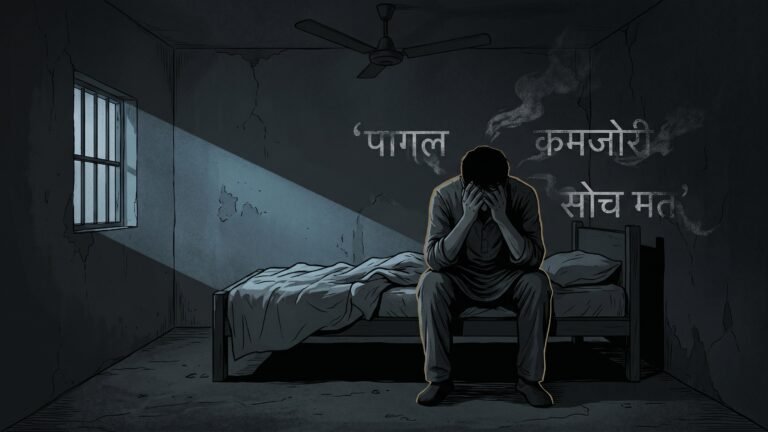
This silence has a structural ally: the language itself. Hindi and most Indian regional languages have no precise equivalent for “depression” as a clinical condition. “Udaas hona” — feeling sad — does not carry the same weight. “Dimag kharab hai” — the mind is damaged — is used casually and pejoratively. The absence of language for a thing makes it harder to ask for help with that thing.
The result is a population that is suffering — quietly, persistently, and largely alone — inside some of the most densely populated environments in the world. You can be surrounded by 1.4 billion people and still have nobody to talk to about the thing that is destroying you from the inside.
That is not a metaphor. For hundreds of millions of Indians, it is a daily reality.
What Exists — And What Is Still Missing
It would be inaccurate to say nothing has changed. Something has.
The government launched Tele MANAS in October 2022 — a national tele-mental health programme offering free counselling in 20 languages across 36 states and union territories. By February 2025, the helpline had handled over 18.27 lakh calls. 53 cells are operational. The WHO recognised Tele MANAS as an innovative model for accessible mental health care in India.
The Economic Survey 2024–25 — for only the second consecutive time — included mental health as a macroeconomic priority. The government sanctioned 25 Centres of Excellence to train more postgraduate mental health professionals. Mental health services are being introduced in all 22 new AIIMS.
These are meaningful steps. They are also vastly insufficient relative to the scale of the problem.
What Exists vs What Is Needed
What exists
- 53 Tele MANAS cells
- Mental Healthcare Act 2017
- National Mental Health Programme
- 25 new Centres of Excellence
- Mental health in 22 new AIIMS
- Growing private therapy market
What is still missing
- Mental health in primary schools
- Rural psychiatrist access
- Affordable private therapy
- Anti-stigma national campaigns
- Mental health in workplaces
- Community counsellor network
18.27 lakh calls to Tele MANAS across 3 years sounds significant. Against a population of 200 million who need support — it is the beginning of a beginning. Not a solution.
The Uncomfortable Conclusion
India is not failing at mental health because Indians are weak or because the government is uniquely callous. India is failing at mental health because it made the same calculation that most developing countries make: that visible infrastructure — roads, hospitals, schools, power — takes priority over invisible infrastructure — the systems that keep minds intact.
The problem with that calculation is the compounding interest on the debt. Every year of untreated mental illness is a year of reduced productivity, broken relationships, escalating healthcare costs, and lives that end before they should. The USD 1.03 trillion projected loss between 2012 and 2030 is not a projection from the distant future. It is already happening. It has been happening for decades.
The people who are suffering inside this system did not create it. They are navigating it — imperfectly, quietly, mostly alone — with whatever internal resources they have. The fact that so many of them continue to function, to work, to raise families, to carry their lives forward without any institutional support, is not proof that the system is adequate. It is proof of what people can endure when they have no choice.

The system is failing. The people inside it are not. That distinction matters — because the language of mental health in India still too often places the burden on the individual to be resilient enough, strong enough, spiritual enough to survive a system that was never built to support them. That framing serves the system. It does not serve the people.
If you are struggling and need to speak to someone
- Tele MANAS: 14416 — free, 24/7, 20 languages, government helpline
- iCall (TISS): 9152987821 — free, trained counsellors, confidential
- Vandrevala Foundation: 1860-2662-345 — 24/7, multilingual, free
- NIMHANS helpline: 080-46110007 — Monday to Saturday
A country’s mental health is not measured by how many wellness apps it produces. It is measured by what happens to the person in the most remote district, in the lowest income bracket, in the most stigmatised situation — when they finally decide to ask for help. India has not yet answered that question well. It has time to answer it differently.
— Agyat Vyakti
mental health India, mental health India 2026, mental health crisis India, mental health statistics India, depression in India, anxiety in India, mental health awareness India, mental health treatment India, mental health support India, India mental health data, mental illness India, mental health India facts, psychiatric care India, psychiatrist India shortage, mental health treatment gap India, India mental health gap, mental health access India, mental health rural India, mental health urban India, NMHS India, national mental health survey India, mental health budget India, mental health spending India, mental healthcare act 2017, mental health policy India, tele MANAS India, mental health helpline India, free mental health India, online therapy India, mental health app India, therapy India affordable, counselling India, psychologist India, psychiatrist shortage India, mental health doctors India, WHO mental health India, mental health WHO India, depression statistics India, anxiety statistics India, mental health burden India, DALYs India mental health, suicide rate India, India suicide statistics, student mental health India, youth mental health India, adolescent mental health India, school mental health India, NCERT mental health survey, mental health students India, Kota student mental health, JEE mental health, NEET student stress, academic pressure mental health India, mental health stigma India, stigma mental illness India, India mental health taboo, mental health conversation India, breaking stigma India, mental health workplace India, employee mental health India, burnout India, workplace stress India, mental health women India, mental health men India, mental health elderly India, mental health rural access India, mental health village India, community mental health India, mental health language India, Hindi mental health, regional language mental health India, mental health awareness campaign India, World Mental Health Day India, mental health economic impact India, mental health productivity India, mental health GDP India, India mental health investment, mental health funding India, mental health infrastructure India, government mental health India, AIIMS mental health, mental health NIMHANS, central institute psychiatry, mental health NGO India, mental health startup India, mental health technology India, AI mental health India, mental health digital India, iCall India, Vandrevala Foundation India, mental health app India free, online counselling India, therapy app India, mental health recovery India, depression recovery India, anxiety treatment India, mental health medication India, antidepressants India, mental health diagnosis India, undiagnosed mental illness India, untreated depression India, untreated anxiety India, mental health resources India, mental health first aid India, mental health education India, mental health literacy India, agyatvyakti mental health, mental health reality India, India healthcare mental health, mental health primary care India, integrated mental health India